
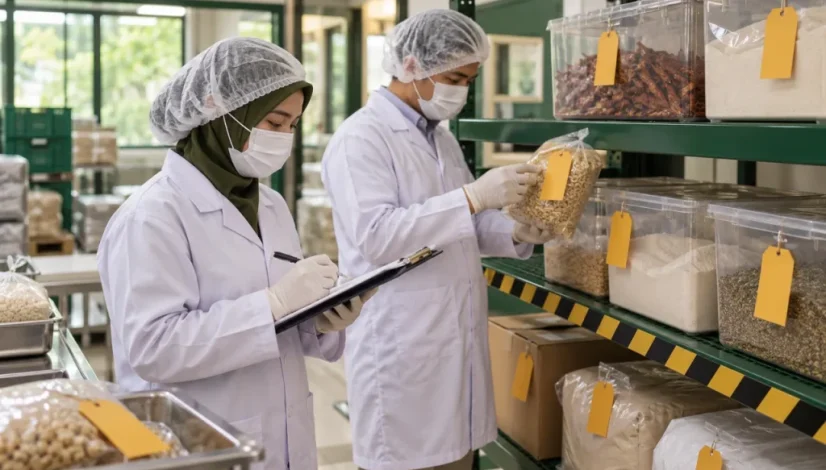
Returned Ingredients and Nonconforming Goods: Maintaining Halal Control in Regular Certification
Publisher: LPH Baslan Hugo Trea
Published:
Business actors are often faced with the situation of returned materials or goods not meeting specifications that may affect the halal status of products. In the context of regular halal certification, the management of such goods must be integrated with the documentation and processes that will be examined by the Halal Inspection Laboratory (LPH) and the final assessment by BPJPH. This article explains practical steps to control returned materials and non-conforming goods without assuming the certificate issuance outcome.
The role of LPH and BPJPH in the regular certification pathway
It is important to know that in the regular halal certification pathway, LPH conducts inspection and/or halal testing of products, while BPJPH issues the halal certificate. Document preparation and records of material control are crucial during LPH inspection. Business actors need to prepare data on the business, products, materials, facilities, and processes according to the scope of application, which includes food, beverages, chemical products, consumer goods, and distribution services.
Risks of returned materials and non-conforming goods to halal status
Returned materials and non-conforming goods can pose risks of cross-contamination, mishandling, or confusion in the production chain. These risks are relevant to all scopes of regular halal certification, including products tested by LPH Baslan Hugo Trea. Therefore, systematic and documented control helps demonstrate compliance with inspection requirements and internal quality standards.
Control principles that must be applied
- Impartiality and confidentiality: Ensure that the procedures for handling returned materials do not affect the independence of inspections and maintain the confidentiality of commercial information in accordance with quality guidelines.
- Document control: Record the origin, batch number, reason for return, and decision status for each item. These documents are important when the LPH reviews the material's traceability.
- Physical separation: Store returned or non-conforming materials in a separate area with clear labeling to prevent uncontrolled reuse.
- Handling complaints and appeals: Implement a mechanism for recording complaints, investigating root causes, and documenting corrective actions. This process is also relevant for compliance inspections by external parties.
Practical operational steps for business actors
- Identification and triage: Immediately identify returned goods based on the reason (quality, labeling, packaging) and conduct triage to determine whether the material can be repaired, safely recycled, or must be isolated.
- Labeling and isolation: Label the status regarding halal status (e.g., requires verification, not for production) and store separately from materials suitable for production.
- Batch reconciliation: Link each returned material with original documents (SOP, supplier, batch number) so that when the LPH conducts an inspection, the material history can be traced.
- Cross-contamination risk assessment: Evaluate the process to minimize contact between returned materials and halal materials suitable for production; implement cleaning and equipment validation as necessary.
- Record corrective actions: Every decision (e.g., repair, destruction, return to supplier) must be fully documented, including reasons and approving parties.
Distinguishing official requirements and practical recommendations
It is important to distinguish between official requirements that serve as the reference for inspections by LPH/BPJPH and internal practices recommended for risk management. Official requirements related to halal certification are set within the regular scope—business actors must prepare business data, products, ingredients, facilities, and processes in accordance with the submission. Meanwhile, operational actions such as physical separation, additional labeling, or improved workflow are practical recommendations that help fulfill official requirements and facilitate inspection.
The management of returned materials and non-conforming goods is part of the quality system that will be assessed during the inspection by LPH such as LPH Baslan Hugo Trea. However, such inspections do not guarantee certificate issuance; the authority for issuing halal certificates lies with BPJPH. Business actors must maintain impartiality, confidentiality, document control, as well as complaint and appeal mechanisms in accordance with applicable quality guidelines.
Practical steps that can be immediately implemented:
- Create a standard SOP for the triage of returned materials and standardized status labels.
- Keep source documents for each batch and record handling decisions centrally.
- Establish separate storage areas and schedules for cleaning and verification of equipment.
- Train staff on complaint recording, root cause investigation, and corrective actions.
- Prepare a clear documentation package when submitting inspections to LPH to facilitate traceability review of materials.
Official references
Learn regular halal inspection scheme and LPH Baslan Hugo Trea service documents.